Back to Buffer solutions

Buffer

Tris-Borate-EDTA (TBE) Buffer

This guide describes the preparation of Tris-Borate-EDTA Buffer at a defined molarity for laboratory use.

23 calculators, 27 buffer and 44 stock solution recipes, every unit from M to aM

BioCalculator preview

How to make it

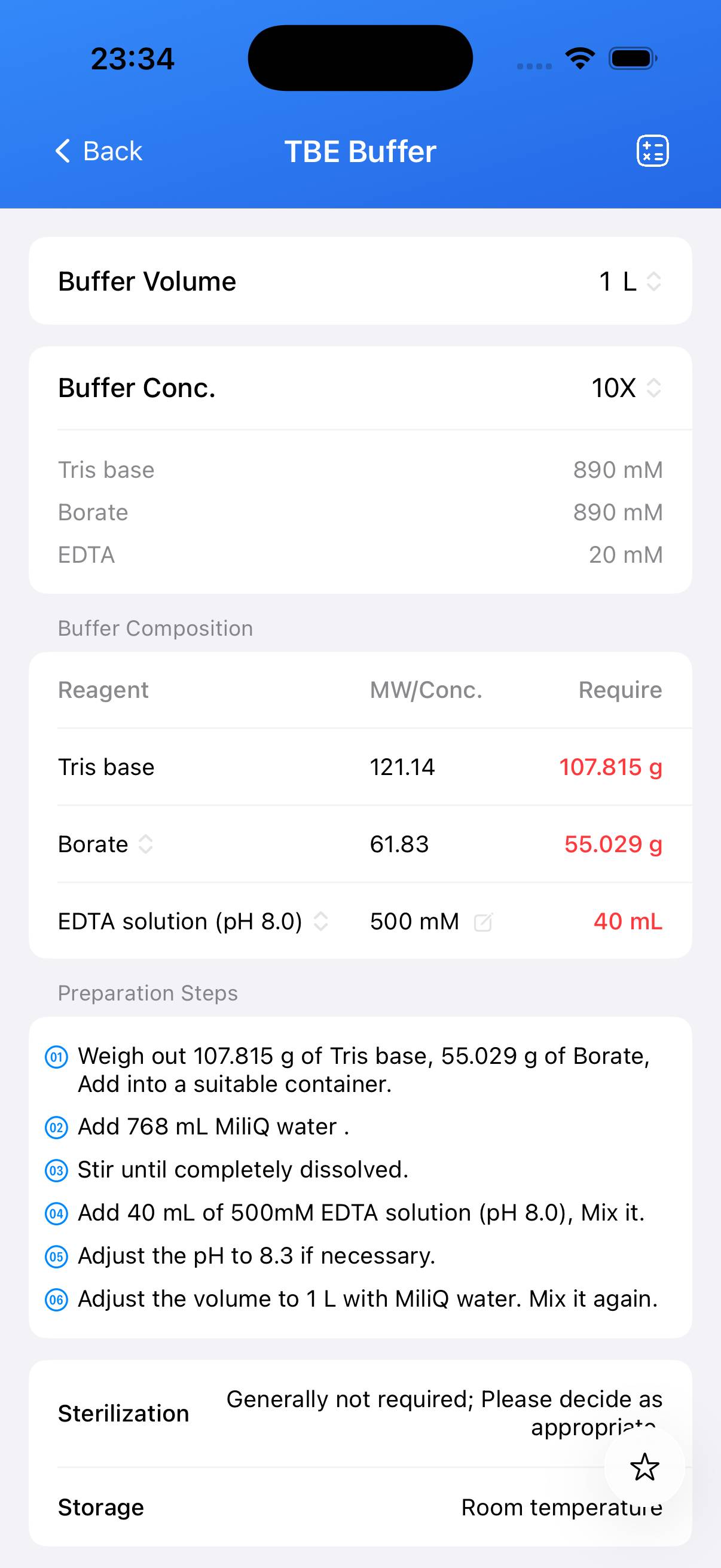
1 L of 10X

ReagentAmount
Tris baseC₄H₁₁NO₃107.815 g
BorateH₃BO₃55.029 g
EDTA solution (pH 8.0)500 mM40 mL

Using another form of EDTA: C₁₀H₁₄N₂O₈·2Na·2H₂O 7.445 g; C₁₀H₁₆N₂O₈ 5.845 g; C₁₀H₁₄N₂O₈·2Na 6.724 g.

  1. Weigh out 107.815 g of Tris base, 55.029 g of Borate into a suitable container.
  2. Add 768 mL of ultrapure water.
  3. Stir until completely dissolved.
  4. Add 40 mL of 500 mM EDTA solution (pH 8.0) and mix.
  5. Adjust the pH to 8.3 if necessary.
  6. Adjust the volume to 1 L with Milli-Q water. Mix it again.

For 1 L of 1X working solution, bring 100 mL of the 10X stock to 1 L with water.

Other volumes and concentrations, and other forms of each reagent, can be calculated in the BioCalculator app.

Reference: Sambrook J, Russell DW. Molecular Cloning: A Laboratory Manual, 3rd ed. Cold Spring Harbor Laboratory Press; 2001.

Tris-Borate-EDTA (TBE) buffer is a commonly used electrophoresis buffer for nucleic acid analysis, especially suitable for the separation of small DNA fragments.

Tris-Borate-EDTA (TBE) Buffer – 1X Working Solution Composition

NameFormulaConcentration (1X)CAS
Tris baseC₄H₁₁NO₃89 mM77-86-1
BorateH₃BO₃89 mM10043-35-3
EDTAC₁₀H₁₆N₂O₈2 mM60-00-4

Applications of Tris-Borate-EDTA (TBE) Buffer

TBE buffer is widely used for agarose and polyacrylamide gel electrophoresis of DNA. Compared with TAE buffer, TBE provides higher buffering capacity and more stable pH during long electrophoresis runs. It offers better resolution for small DNA fragments and is commonly used in DNA sizing, restriction fragment analysis, and high-resolution electrophoresis applications.

Preparation Tips, Sterilization, and Storage

  • The use of EDTA solution or EDTA·2Na·2H₂O is recommended.
  • Some studies have shown that buffers prepared with EDTA (free acid) generate less heat during electrophoresis, but require longer preparation time.
  • EDTA (free acid) is extremely difficult to dissolve. It is recommended to prepare an EDTA stock solution first.
  • If a small amount of precipitate forms, it can be redissolved by placing the solution in a 37°C water bath and does not affect use. If precipitate remains after water bath treatment, discard the solution.
  • Sterilization: usually not required; select as needed.
  • Storage: room temperature.
BioCalculator

Calculate with your own values in BioCalculator

Set the buffer volume and concentration in the app to calculate the amount of each component, and follow the preparation steps.

In the app

  • Any of 27 buffers at the volume and strength you need, such as 1× or 10×
  • The amount of each component, weighed as a solid or taken from your own stock solutions
  • Preparation steps and notes for every recipe
  • Keep the recipes you use as favourites

See the store for pricing and system requirements.

iOS app screenshot