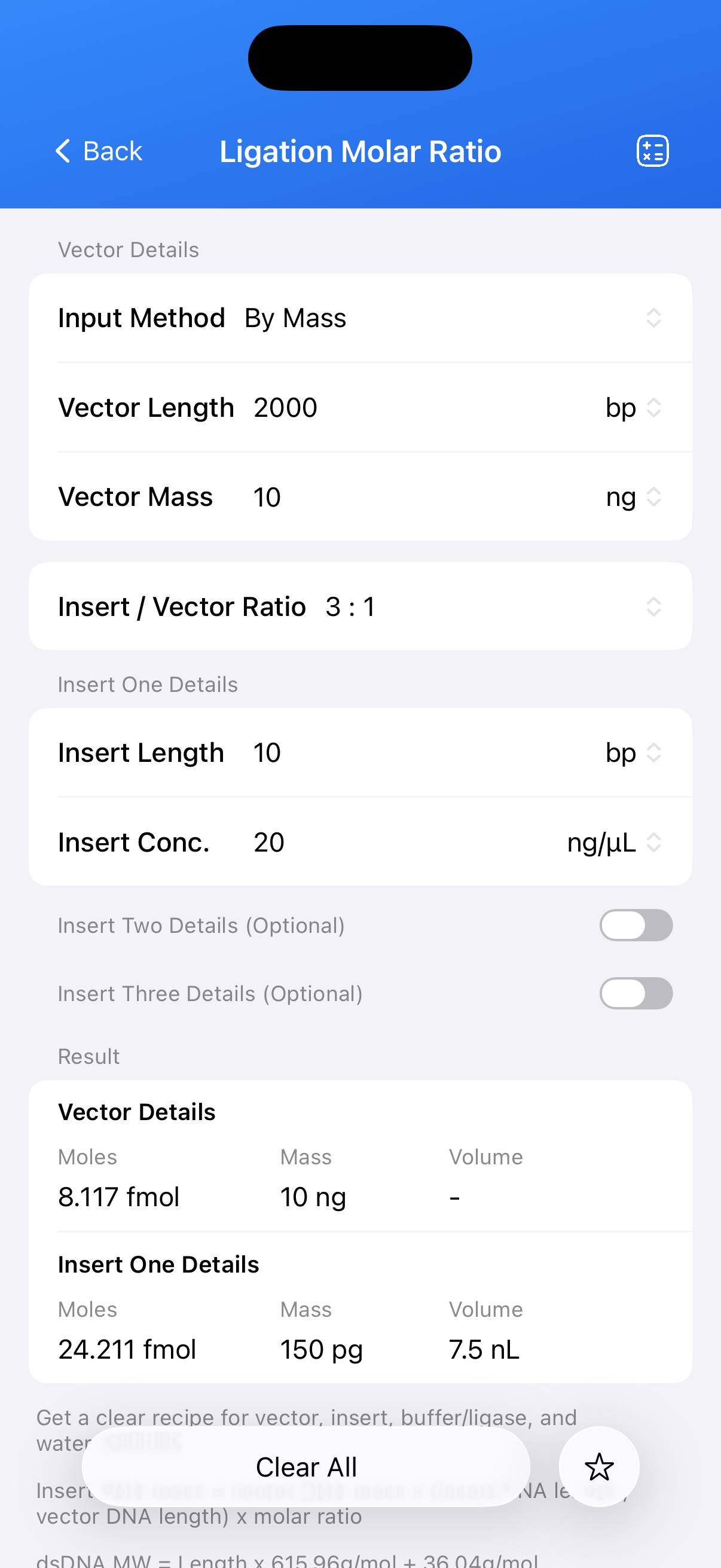
Insert Amount Calculator for Molecular Cloning
Designed for molecular cloning workflows, this calculator determines the exact amount of insert DNA required based on the amount of vector DNA and a user-defined insert-to-vector molar ratio. It simplifies ligation setup by providing a complete and precise reaction recipe.
Key Features
- Multiple Insert Support:
Plan ligation reactions involving up to three different insert fragments simultaneously, enabling standard cloning as well as multi-fragment assemblies. - Flexible Vector Input:
Specify the vector amount directly by mass (ng), or calculate it from a stock solution using concentration (ng/µL, fmol/µL, or nM) and volume. - Flexible Insert Input:
Insert stock concentrations can be entered in ng/µL, fmol/µL, or nM, allowing seamless integration with different quantification methods. - Molar Ratio–Based Calculation:
Enter the desired Insert:Vector molar ratio (e.g., 3:1). The calculator determines the required amount of each insert in both picomoles (pmol) and nanograms (ng). - Precise Volume Calculation:
Calculates the exact volume (µL) of each insert stock solution needed for the ligation reaction. - Complete Reaction Volume Planning:
Input the desired total ligation volume and the volume occupied by buffer and ligase. The calculator automatically determines the amount of water required to complete the reaction. - Customizable Molecular Weight per Base Pair:
Optionally override the standard average molecular weight per base pair to match specific experimental assumptions.
Why Use This Tool?
Manual ligation calculations are time-consuming and prone to error, especially when working with multiple inserts or different concentration units. This calculator eliminates tedious arithmetic, reduces setup mistakes, and provides a clear, step-by-step recipe for vector, insert(s), buffer/ligase, and water volumes.
Whether you are performing routine cloning or complex multi-fragment ligations, this tool helps streamline experimental planning and improves reproducibility in molecular cloning workflows.