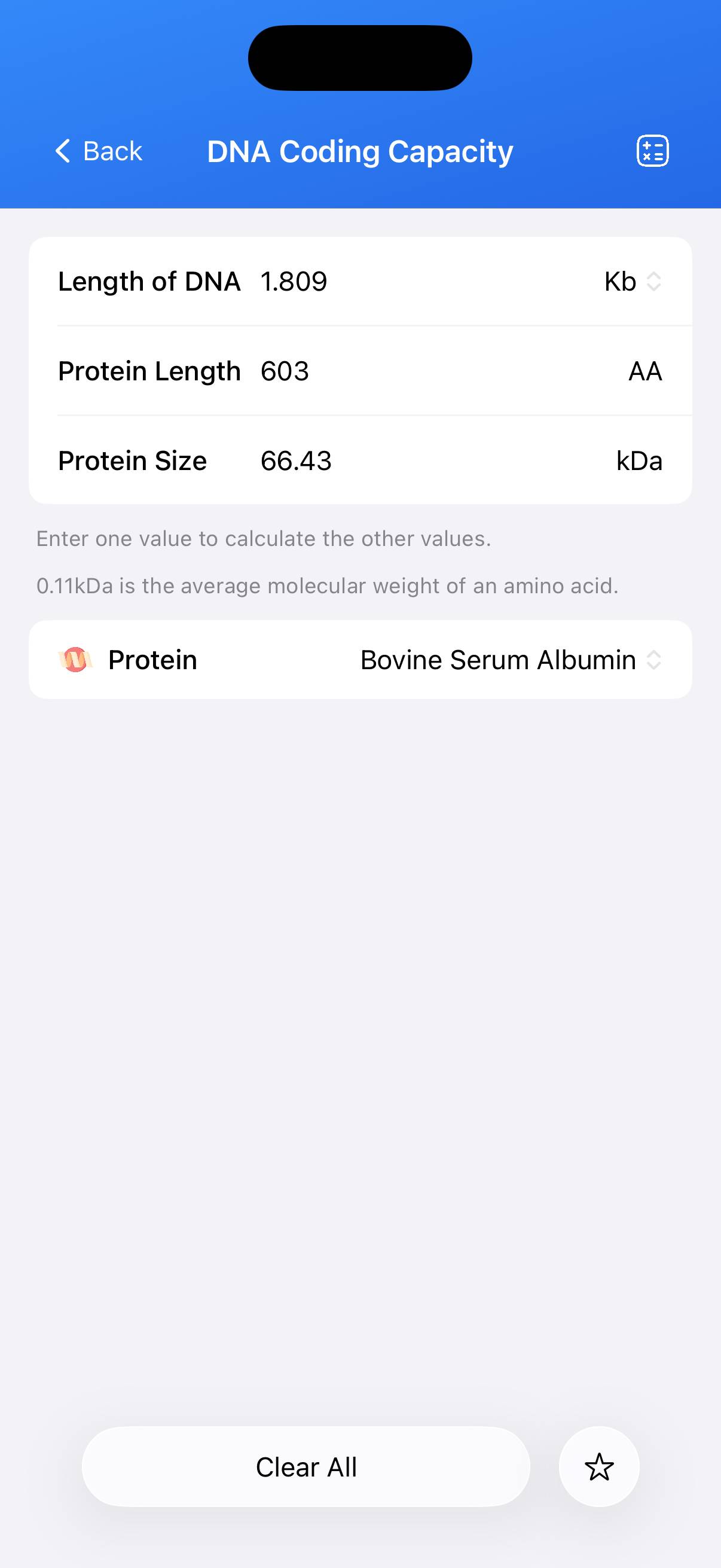
DNA's protein coding capacity refers to the small portion of its sequence (less than 2% in humans) that contains genes providing instructions for building proteins, using a triplet code (codons) to specify amino acids, while the vast majority of DNA is non-coding but plays crucial regulatory roles. The coding capacity determines the potential number of proteins, though biological processes like alternative splicing create more unique proteins than genes. This tool is only a very basic estimate of DNA coding capacity.
Key Aspects of Protein Coding Capacity
- Small Percentage:
Protein-coding genes make up a tiny fraction of the entire genome, with estimates around 1-2% of total - The Triplet Code:
DNA uses sequences of three bases (codons) to code for specific amino acids, the building blocks of proteins. - Genes vs. Proteins:
While humans have about 19,000-20,000 protein-coding genes, processes like alternative splicing allow one gene to produce multiple different proteins. - Non-Coding DNA:
The other ~98% of DNA, once called "junk," is vital for gene regulation, including turning genes on and off (like promoters and enhancers). - Calculation:
A simple formula relates DNA length to protein length: Amino Acids Encoded = DNA Bases / 3, with tools available to estimate protein size from DNA length.
The Formula
The relationship is governed by the following formula:
Encoded amino acids = DNA length (bases) / 3
DNA length = 3 x amino acids
Estimated protein size = amino acids x 0.11 kDa
0.11kDa is the average molecular weight of an amino acid
How it Works
- Transcription:
A protein-coding DNA sequence (gene) is copied into messenger RNA (mRNA). - Translation:
Ribosomes read the mRNA in codons (three-base units) and assemble corresponding amino acids. - Protein Synthesis:
This chain of amino acids folds into a functional protein.
Significance
- Functional DNA:
Even though small, coding DNA is critical for biological functions, with related mammals sharing similar functional DNA proportions. - Genomic Complexity:
The non-coding regions, especially regulatory elements, dictate when and where proteins are made, adding immense complexity beyond just the coding sequence.