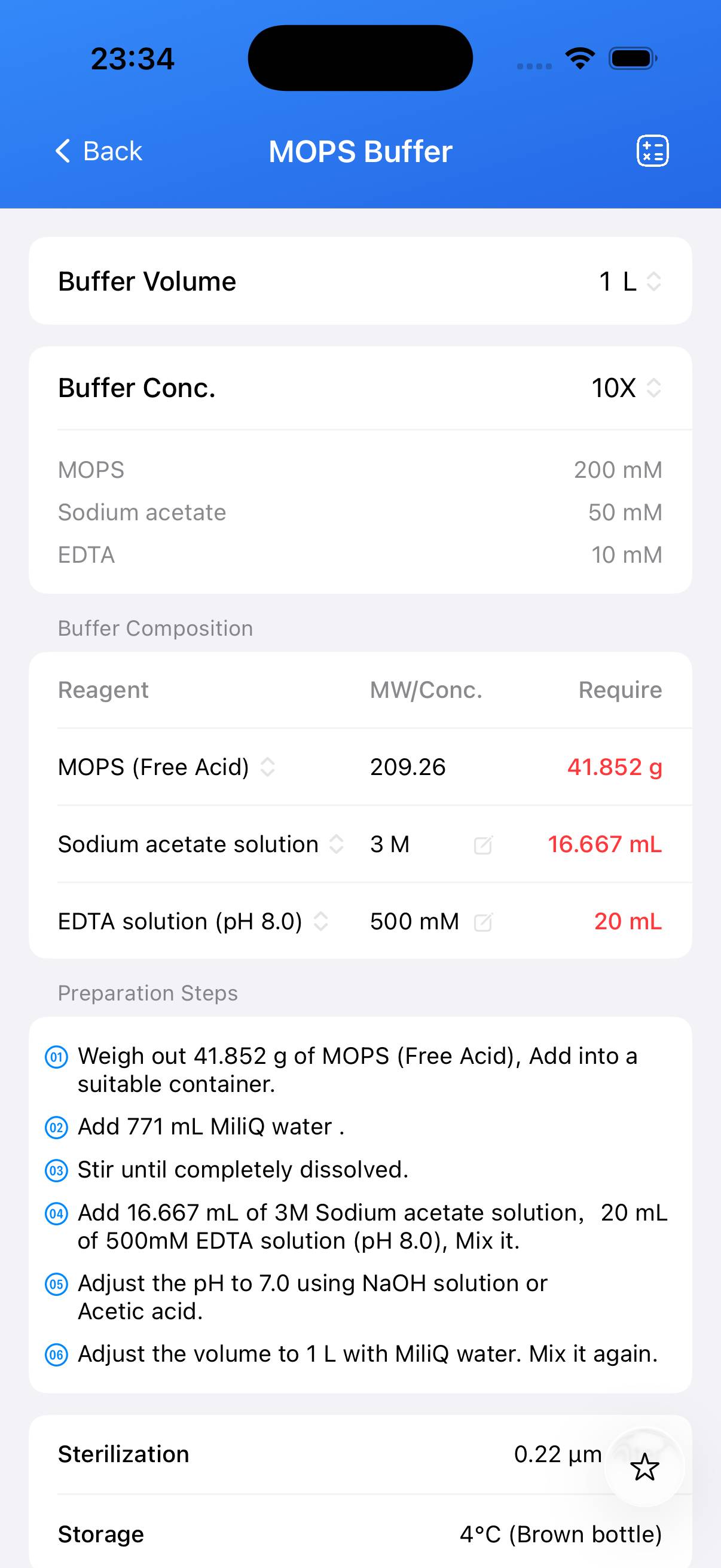
MOPS buffer is a zwitterionic buffering system commonly used in molecular biology, particularly for RNA-related applications, due to its effective buffering capacity near neutral pH and low metal-binding properties.
MOPS Buffer – 1X Working Solution Composition
| Name | Formula | Concentration (1X) | CAS |
|---|---|---|---|
| MOPS | C₇H₁₅NO₄S | 20 mM | 1132-61-2 |
| Sodium acetate | C₂H₃O₂Na | 5 mM | 127-09-3 |
| EDTA | C₁₀H₁₆N₂O₈ | 1 mM | 60-00-4 |
Applications of MOPS Buffer
MOPS buffer is widely used in molecular biology, particularly for RNA electrophoresis (such as denaturing agarose gels), RNA handling, and enzymatic reactions requiring stable buffering near pH 7.0. Its minimal interaction with metal ions and low UV absorbance make it suitable for sensitive biochemical and nucleic acid applications.
Preparation Tips, Sterilization, and Storage
- Before adjusting the pH, measure the pH only after all components are completely dissolved. Typically, use NaOH when preparing with MOPS free acid, and acetic acid when preparing with MOPS sodium salt.
- Autoclaving is not recommended, as high temperatures may cause the solution to turn yellow.
- Freshly prepared solutions are colorless and transparent. A pale yellow color over time does not affect use; discard the solution if the color darkens.
- Anhydrous sodium acetate is hygroscopic. Avoid prolonged exposure during weighing.
- EDTA (free acid) is extremely difficult to dissolve and requires alkaline conditions. Preparing an EDTA stock solution is recommended; EDTA solution or EDTA·2Na·2H₂O is preferred.
- For RNA applications, perform DEPC treatment throughout the entire preparation process.
- Sterilization: 0.22 μm filtration.
- Storage: 4°C in an amber bottle.