Back to Buffer solutions

Buffer

Tris-Acetate-EDTA (TAE) Buffer

This guide describes the preparation of Tris-acetate-EDTA Buffer at a defined molarity for laboratory use.

23 calculators, 27 buffer and 44 stock solution recipes, every unit from M to aM

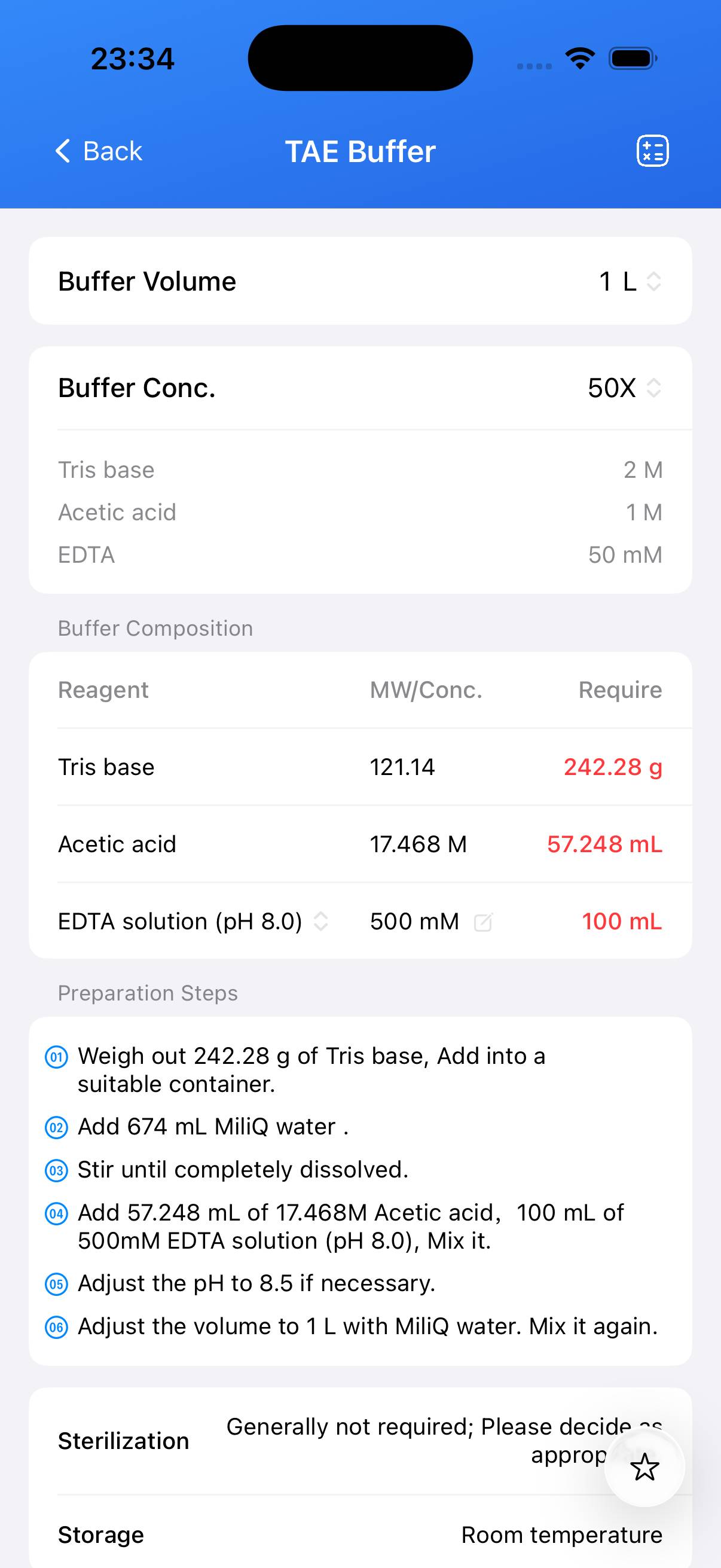
BioCalculator preview

How to make it

1 L of 50X

ReagentAmount
Tris baseC₄H₁₁NO₃242.28 g
Acetic acid17.468 M57.248 mL
EDTA solution (pH 8.0)500 mM100 mL

Using another form of EDTA: C₁₀H₁₄N₂O₈·2Na·2H₂O 18.612 g; C₁₀H₁₆N₂O₈ 14.612 g; C₁₀H₁₄N₂O₈·2Na 16.811 g.

  1. Weigh out 242.28 g of Tris base into a suitable container.
  2. Add 674 mL of ultrapure water.
  3. Stir until completely dissolved.
  4. Add 57.248 mL of 17.468 M Acetic acid, 100 mL of 500 mM EDTA solution (pH 8.0) and mix.
  5. Adjust the pH to 8.5 if necessary.
  6. Adjust the volume to 1 L with Milli-Q water. Mix it again.

For 1 L of 1X working solution, bring 20 mL of the 50X stock to 1 L with water.

Other volumes and concentrations, and other forms of each reagent, can be calculated in the BioCalculator app.

Reference: Sambrook J, Russell DW. Molecular Cloning: A Laboratory Manual, 3rd ed. Cold Spring Harbor Laboratory Press; 2001.

Tris-acetate-EDTA (TAE) buffer is a commonly used electrophoresis buffer for nucleic acid analysis, providing a stable pH environment and effective chelation of divalent metal ions.

Tris-acetate-EDTA (TAE) Buffer – 1X Working Solution Composition

NameFormulaConcentration (1X)CAS
Tris baseC₄H₁₁NO₃40 mM77-86-1
Acetic acidCH₃CO₂H20 mM64-19-7
EDTAC₁₀H₁₆N₂O₈1 mM60-00-4

Applications of Tris-acetate-EDTA (TAE) Buffer

TAE buffer is widely used for agarose gel electrophoresis of DNA and RNA. Tris provides buffering capacity, acetic acid adjusts ionic strength and pH, and EDTA chelates divalent cations such as Mg²⁺, inhibiting nuclease activity. TAE buffer offers good resolution for large DNA fragments and is commonly used in cloning, restriction analysis, and routine nucleic acid separation.

Preparation Tips, Sterilization, and Storage

  • The use of EDTA solution or EDTA·2Na·2H₂O is recommended.
  • Some studies have shown that buffers prepared with EDTA (free acid) generate less heat during electrophoresis, but require longer preparation time.
  • EDTA (free acid) is extremely difficult to dissolve and requires pH 8.0. It is recommended to prepare an EDTA stock solution first.
  • The molar concentration of glacial acetic acid (100% acetic acid) is approximately 17.5 M.
  • If a small amount of precipitate forms, it can be redissolved by placing the solution in a 37°C water bath and does not affect use. If precipitate remains after water bath treatment, discard the solution.
  • Sterilization: usually not required; select as needed.
  • Storage: room temperature.
BioCalculator

Calculate with your own values in BioCalculator

Set the buffer volume and concentration in the app to calculate the amount of each component, and follow the preparation steps.

In the app

  • Any of 27 buffers at the volume and strength you need, such as 1× or 10×
  • The amount of each component, weighed as a solid or taken from your own stock solutions
  • Preparation steps and notes for every recipe
  • Keep the recipes you use as favourites

See the store for pricing and system requirements.

iOS app screenshot