Back to Buffer solutions

Buffer

Phosphate Buffered Saline (PBS)

This guide describes the preparation of Phosphate Buffered Saline at a defined molarity for laboratory use.

23 calculators, 27 buffer and 44 stock solution recipes, every unit from M to aM

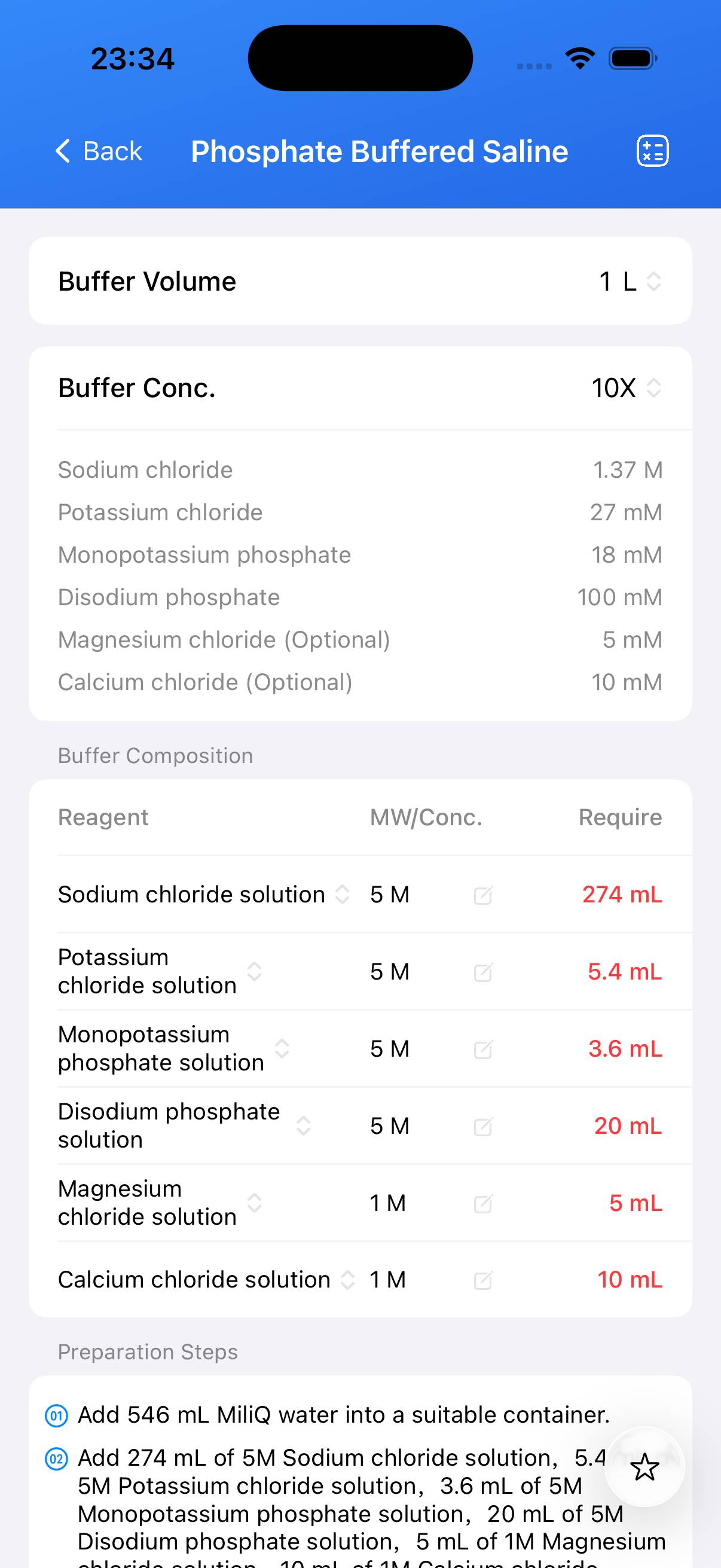
BioCalculator preview

How to make it

1 L of 10X

ReagentAmount
Sodium chlorideNaCl80.063 g
Potassium chlorideKCl2.013 g
Monopotassium phosphateKH₂PO₄2.45 g
Disodium phosphate dihydrateNa₂HPO₄·2H₂O17.799 g
Magnesium chloride hexahydrate (optional)MgCl₂·6H₂O1.017 g
Calcium chloride dihydrate (optional)CaCl₂·2H₂O1.47 g

Using another form of Disodium phosphate: Na₂HPO₄·7H₂O 26.807 g; Na₂HPO₄·12H₂O 35.814 g; Na₂HPO₄ 14.196 g.

Using another form of Magnesium chloride: MgCl₂ 476.05 mg.

Using another form of Calcium chloride: CaCl₂·4H₂O 1.831 g; CaCl₂·6H₂O 2.191 g; CaCl₂ 1.11 g.

  1. Weigh out 80.063 g of Sodium chloride, 2.013 g of Potassium chloride, 2.45 g of Monopotassium phosphate, 17.799 g of Disodium phosphate dihydrate, 1.017 g of Magnesium chloride hexahydrate (optional), 1.47 g of Calcium chloride dihydrate (optional) into a suitable container.
  2. Add 800 mL of ultrapure water.
  3. Stir until completely dissolved.
  4. (Optional when 1X) Adjust the pH to 7.2 ~ 7.4 with HCl.
  5. Adjust the volume to 1 L with Milli-Q water. Mix it again.
  6. (Optional) One can filter the solution to remove any undissolved material.

For 1 L of 1X working solution, bring 100 mL of the 10X stock to 1 L with water.

Other volumes and concentrations, and other forms of each reagent, can be calculated in the BioCalculator app.

Reference: Sambrook J, Russell DW. Molecular Cloning: A Laboratory Manual, 3rd ed. Cold Spring Harbor Laboratory Press; 2001.

Phosphate Buffered Saline (PBS) is a widely used biological buffer in research laboratories, isotonic and compatible with most cells, with pH close to physiological conditions.

Phosphate Buffered Saline (PBS) – 1X Working Solution Composition

NameFormulaConcentration (1X)CAS
Sodium chlorideNaCl137 mM7647‑14‑5
Potassium chlorideKCl2.7 mM7447‑40‑7
Monopotassium phosphateKH₂PO₄1.8 mM7778‑77‑0
Disodium phosphateNa₂HPO₄10 mM7558‑79‑4
Magnesium chloride (Optional)MgCl₂0.5 mM7786-30-3
Calcium chloride (Optional)CaCl₂1 mM10043‑52‑4

Common Uses of PBS

PBS is widely used in molecular biology and cell culture because it is isotonic and non-toxic to most cells. Applications include washing cells or tissues, diluting biological samples, reagent preparation, container rinsing, immunoassays, and molecular biology workflows. PBS is also used to maintain osmotic balance in experiments.

Preparation Tips, Sterilization, and Storage

  • The pH of 10X PBS solution is 6.8. When diluted to 1X, the pH becomes 7.4.
  • After preparation with Milli-Q water, 1X PBS usually reaches pH 7.2–7.4 without adjustment.
  • If strict pH control is required, measure and adjust pH after dilution.
  • Storing concentrated PBS at 4°C may lead to salt precipitation. Shake well before use; discard if particles persist.
  • Disodium phosphate is highly hygroscopic; avoid long exposure during weighing.
  • Calcium chloride and magnesium chloride are optional; add according to experimental needs.
  • Anhydrous CaCl₂ and MgCl₂ generate heat upon dissolution; handle with care.
  • Sterilization: 0.22 μm filtration or autoclaving.
  • Storage: room temperature or 4°C.
BioCalculator

Calculate with your own values in BioCalculator

Set the buffer volume and concentration in the app to calculate the amount of each component, and follow the preparation steps.

In the app

  • Any of 27 buffers at the volume and strength you need, such as 1× or 10×
  • The amount of each component, weighed as a solid or taken from your own stock solutions
  • Preparation steps and notes for every recipe
  • Keep the recipes you use as favourites

See the store for pricing and system requirements.

iOS app screenshot